Updated October 2026 V7 platform · 86.4 Wh
How to Extend Dyson V7 Battery Runtime: Change the Habits Before You Change the Pack
Runtime is not one number — it is stored energy divided by whatever the machine is drawing at the time. On a V7 you control the draw twice per clean (mode and floor), the airflow twice more (bin and filter), and the long-term health of the cells every time you charge or store it. Fix those five and most owners get a usable clean back without spending anything. If the pack is still the limit afterwards, the watt-hour comparison at the end of this guide tells you honestly what a bigger pack can and cannot do.
No minute figures here. AussieBatt publishes no runtime minutes for any battery, so every number below is either a published price, a published specification or arithmetic you can check.
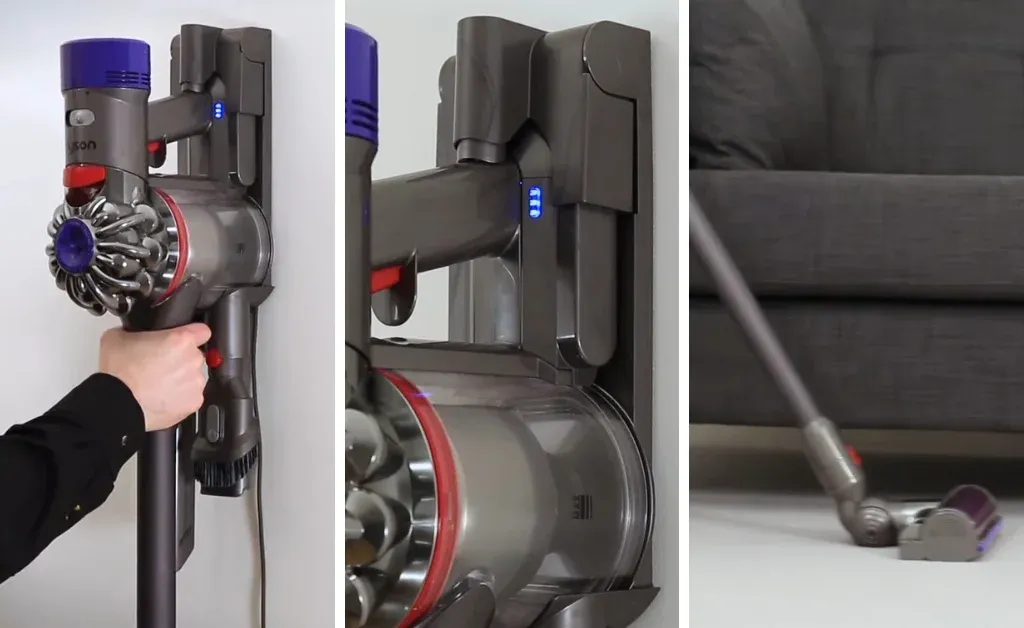
Mode selection: ECO, standard and MAX are not equal draws
What is in this guide
MAX draws markedly more current than standard, and standard more than ECO. Same stored energy, much faster consumption, and more heat generated while it happens — and heat is what ages lithium cells. The V7's trigger is a live power switch, so it is easy to sit at the top of the range without noticing; the machine feels strong, so people assume strong is how it should be used.
Flip the habit: start every clean in the lowest mode that lifts the dirt, and step up only for the patch that needs it — the pet hair in the carpet traffic lane, the crumbs on the stair nosing. Hold the trigger the whole time you are actually sucking, not while you are moving furniture or walking to the next room. On hard floors a soft-roller or non-motorised attachment pulls far less current than a motorised head doing the same square metres.
Clean most of the house in the lowest mode that picks the dirt up. Mode choice buys more runtime per charge than any accessory, any trick and any replacement pack you could buy this week.
Empty the bin before it is full, not after
The V7 has to drive all of its air through the bin and the cyclone. A bin packed to the shuffle plate leaves less room for that air, the motor compensates, and the current draw climbs while suction drops — the worst combination for runtime. Empty it when the debris reaches about the halfway mark, and again before you put the machine away, rather than once a month when it is full to the top.
Empty over a bin with the mouth pointing straight down and let gravity do the work; tap the outside of the cyclone a few times to shake dust off the mesh. Do not pack debris down with your hand, and keep the sealing faces clear of grit — a blockage in the inlet where the wand clicks in will imitate a dying battery perfectly, which is why the not-holding-charge guide puts airway clearing before anything else.
Filter hygiene: wash, and dry for a full 24 hours
A loaded pre-motor filter is the single most common reason a V7 run time quietly shrinks. Wash it under cold running water with no detergent, no brushing of the mesh and no dishwasher; shake out the water and leave it in moving air until it is completely dry — 24 hours. Refitting a damp filter restricts airflow and sends moisture toward the motor, so it makes both problems worse at once.
A filter that has been washed many times, looks flattened, or reads grey through will not recover with more water. Dyson Australia lists the compatible pre-filter for the V6/V7/V8/DC58/DC59 parts family at AU $35.00 — the cheapest runtime upgrade on this list. [CONFIRM the filter washing interval we quote to customers]
Two minutes of checking that pays for itself
Once a month, look at three things while the machine is off: the filter face, the bin inlet, and the brush bar. Cut wound hair off the bar with scissors, wipe the inlet clear, and confirm the filter is dry and seated. All three are airflow, and airflow is what your run time is actually measured against.
Pick the head for the floor
A motorised head spinning against deep pile carpet is a second load on the pack that you do not need when you are doing the hallway tiles.
Use the lowest-resistance tool that cleans the surface: hard-floor head or non-motorised tool on tiles, boards and vinyl; motorised head where there is carpet pile; the crevice tool and soft brush for shelves, sills and car seats, which cost almost nothing in current. Keep the brush bar clear of hair and thread, and replace the head if the bar no longer spins freely — a jammed brush bar is a brake on the battery.
Dyson publishes head-by-head and mode-by-mode runtimes for each model, which is where you should look for figures; we deliberately do not restate them, and we do not publish minute claims of our own.
Charging habits: no memory effect, but still habits worth changing
Lithium-ion does not suffer the memory effect that nickel-cadmium packs did, so you do not need to run the V7 flat before every charge, and short top-ups are harmless. Two habits do matter. First, do not leave the pack at 100 % on the dock permanently — a full state of charge combined with the trickle of continuous heat is the condition lithium cells age fastest in. Charge until the charger indicates full, then take it off the dock. Second, never charge a hot pack straight after a hard clean: let it sit on a cool bench for 30–60 minutes first. Charging while warm forces the protection circuit to limit or delay the charge, and you read that partial charge as a bad battery.
If the charge reading looks wrong, calibrate: full uninterrupted charge, run the machine to shutdown, rest about 30 minutes, full charge again. That fixes the gauge, not the cells. Use the correct 21.6 V Dyson charger — never a charger from another voltage family — and if the pack will not charge at all, work through the contact and temperature checks in the charger page.
Nothing conditions a worn lithium pack back to life. No deep-discharge cycle, no "leave it on the charger overnight to reset it", no freezer, no running it flat three times in a row, no third-party "rejuvenation" service. Those tricks move air around the fuel gauge; they do not return capacity that the cells have physically lost. If run time has collapsed after a clean filter and a clear airway, the honest options are a new pack or a different cleaning habit — not a ritual.
Storage: the Australian summer is the thing that kills these packs
Our V7 listing publishes storage advice in plain terms: keep the pack at about 40–50 % charge in a cool, dry place between 15 and 25 °C. That is achievable in most of the house and impossible in several places people actually store a vacuum: the tray of a car parked in the sun, a colourbond shed, a garage in the Western Australian or Queensland interior, a laundry with a hot-water-service pipe running past it, or the shelf of an outside cupboard. In a December car the interior can reach temperatures well beyond anything the chemistry tolerates, and one such afternoon can cost more capacity than a year of normal use.
So: store the machine inside, off concrete heat, out of direct sun. Never freeze-store a lithium pack — it is a folk remedy that does nothing good and risks the casing and seals. If the V7 sits unused for weeks, run and recharge it every 2–3 weeks so the cells never drift too low, and leave it at roughly half charge rather than full or empty.
Heat is a safety issue before it is a performance issue
If the pack has been in a hot car or has come out of a long MAX session, let it cool fully before charging. A pack that is too hot to hold comfortably, is swollen, discoloured, burnt-smelling or has been soaked must be retired, not recharged — bag it, keep it away from heat and take it to an Australian household-battery recycler.
The habit, what it costs your pack, what to do instead
| Habit | What it costs | Do this instead |
|---|---|---|
| Cleaning in MAX all the time | Much higher current draw, more heat, faster capacity loss | Start in the lowest mode that lifts the dirt; reserve MAX for stubborn patches |
| Only emptying the bin when it is packed | Restricted airflow, harder work, shorter run per charge | Empty at about half full, and before storing |
| Never washing the filter | Gradual runtime shrink that looks exactly like cell wear | Cold-water wash, no detergent, 24 hour dry; AU $35.00 replacement if it is spent |
| Motorised head on hard floors | Needless current for the same result | Match the head to the floor; keep the brush bar free-spinning |
| Charging straight after a hard clean | Protection limits charge, you get a partial charge | Cool 30-60 minutes on a bench, then charge |
| Living on the dock at 100 % | Faster long-term capacity loss | Charge to full, take it off the dock until next use |
| Storing in a hot car, shed or garage | The fastest capacity killer in Australian summers | Store inside at 15-25 °C, roughly 40-50 % charge |
| Left flat for months | Cells can drop below a safe charge level | Run and recharge every 2-3 weeks while idle; never freezer-store |
A weekend routine that recovers what is recoverable
Do these in one sitting, then judge the machine honestly on the next clean.
- Wash the filter under cold water, shake it out and leave it somewhere with moving air for a full 24 hours. Refit only when bone dry.
- Empty the bin and tap the cyclone clear; check the wand and hose entry for anything lodged.
- Free the brush bar — cut away wound hair and confirm it spins by hand without dragging.
- Wipe the charging contacts dry, then confirm the charger is the 21.6 V model for this family.
- Let the pack reach room temperature if it has been working or sitting somewhere warm.
- Charge uninterrupted to full, then run one clean in the lowest workable mode and judge the result. Still short? Calibrate once, then move to the diagnosis guide.
If the run time is still poor after all six steps, the pack is no longer a behaviour problem. Work through the V7 not-holding-charge checks to confirm it, and the replacement decision list for the signs that a pack is finished.
86.4 Wh versus the 2.0–3.0 Ah packs: arithmetic, not a lab result
Energy is voltage times amp-hours, so the comparison is something you can verify on a calculator. Our V7 pack is 21.6 V × 4.0 Ah = 86.4 Wh. The same platform in 3.0 Ah form stores 21.6 × 3.0 = 64.8 Wh, and a 2.0 Ah pack stores 21.6 × 2.0 = 43.2 Wh. Dividing gives the ratio: 86.4 ÷ 64.8 = 1.33, so a 4.0 Ah pack carries about a third more stored energy than a 3.0 Ah pack of the same voltage; against 2.0 Ah it is 86.4 ÷ 43.2 = exactly double.
What that does not buy you: more suction, a different mode range, or a repair for a blocked airway. Runtime is stored energy divided by draw, so the extra capacity only shows up if the draw is what was limiting you. What it does buy you is headroom — a pack that started 33 % larger will still finish a whole house after a couple of years of normal ageing has taken its share.
The second-pack option. The V7 bay holds one pack, so a spare does not double your runtime in a single clean; it doubles the work you can do before a recharge. Owners who vacuum a large home, or who clean commercially, sometimes keep a second charged pack and swap them. That swap means undoing and refitting the retaining screws each time, so follow the fitting walkthrough and refit snugly rather than forced. If you go this way you will want a second charger or a charge-and-spare routine; [CONFIRM our 21.6V Dyson charger price] — Dyson Australia lists its own charger for this family at AU $40.00.
OEM prices shown are Dyson Australia list prices for the corresponding genuine part, checked on dyson.com.au on 31 October 2026. Dyson changes prices and availability — confirm before relying on the saving figure.
Dyson V7 compatible battery · 21.6 V · 4.0 Ah
In Stock · Grey · orders processed within 24 hours
Dyson V7 battery replacement Australia
- Energy
- 86.4 Wh (21.6 V × 4.0 Ah)
- Versus 3.0 Ah
- 86.4 ÷ 64.8 = 1.33
- Versus 2.0 Ah
- 86.4 ÷ 43.2 = 2.00
- Codes
- 968670-02 · 225403
- Not fit for
- V6, V8, SV07
- Warranty
- 1 year + 30 day money back
Runtime questions from V7 owners
Does a higher Ah battery really give me more runtime?
More stored energy, yes, in direct proportion. 21.6 V times 4.0 Ah is 86.4 Wh against 64.8 Wh at 3.0 Ah, so 86.4 divided by 64.8 is 1.33 - about a third more energy at the same voltage. The minutes you actually get still depend on mode, head, floor and how clean the filters are, so a bigger pack cannot fix a blocked machine.
Will ECO mode pick up pet hair from carpet?
On thin pile and hard floors, usually yes. On deep pile it may not, and that is the case for stepping up only on those passes rather than running the whole house in MAX. Alternating is the habit that costs the pack least.
Should I let the V7 run flat before charging it?
No. Lithium-ion has no memory effect, and regular deep drains are one of the things that age it faster. Top up when convenient, and reserve a full discharge for the calibration routine when the charge reading looks wrong.
Can I charge it in the car or straight after a long clean?
Charge neither hot nor in the heat. Let the pack sit on a cool bench for 30 to 60 minutes after a hard clean before docking it, and never leave it charging somewhere a summer afternoon can reach. A pack that is hot to hold, swollen or burnt smelling must not be charged at all.
Would a second charged pack help me?
It doubles the work you can do between recharges, not the runtime of a single clean, because the bay holds one pack. Swapping means undoing the retaining screws each time, so follow the fitting walkthrough and refit snugly. Ask us about a spare charger before you commit to two packs.
How should I store the V7 over a long holiday?
Cool, dry and indoors at roughly 40 to 50 percent charge, which is the storage guidance on our own V7 listing: 15 to 25 degrees C. Run and recharge it every two to three weeks so the cells never drift too low, and never put a lithium pack in a freezer.
My habits are good and the runtime is still short. What now?
Then the pack is likely degraded. Do the six checks in the not-holding-charge guide - filter, airway, temperature, contacts - and if run time still keeps falling after all of them, replace the pack rather than changing more habits. Orders are processed within 24 hours at our Granville, Sydney warehouse.
Next reads
V7 not holding a charge
The six-check diagnosis order, from free fixes to the point where a pack needs replacing.
Open the diagnosis guideV8 battery usage tips
The same platform one generation on, plus why our V7 and V8 packs are different SKUs.
Open the V8 tipsHow long packs last here
What shortens a pack fastest in Australian conditions, and what to expect from a replacement.
Read the lifespan guideWant the honest answer for your machine?
Tell us your mode habits, your floor types and the code on your pack, and we will say whether you need a filter, a charger or a battery - in that order.